
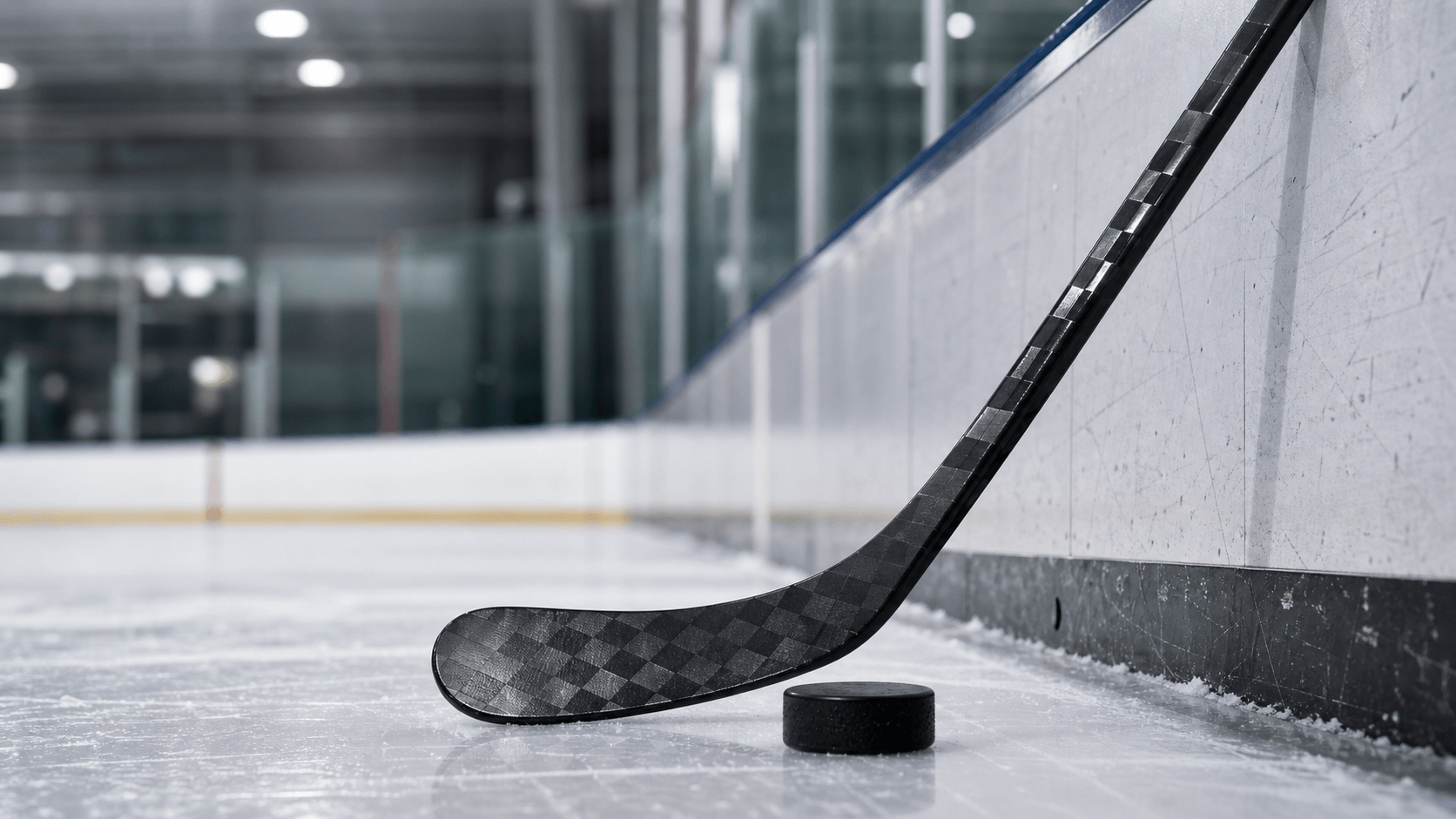
An ice hockey stick blade curve changes how the blade receives, carries and releases the puck. A moderate mid curve is usually the most versatile starting point, a mid-toe curve can support a quicker release near the toe, and a deeper toe curve favors players who deliberately load and release the puck from the front of the blade. The best choice is not simply the most aggressive curve: it is the pattern that matches your shooting mechanics, puck position, preferred lie and level of control.
Key Takeaways
- Mid curve: a balanced, predictable choice for passing, receiving and wrist shots.
- Mid-toe curve: a versatile option with more support for quick releases and toe-based handling.
- Toe curve: a specialized choice for players comfortable controlling the puck near the toe.
- Open face: can help lift the puck, but requires good control to keep passes and shots low.
- Lie and blade profile: matter as much as curve depth because they affect how the blade sits on the ice.
What a Hockey Stick Blade Curve Changes
A hockey stick blade is not defined by one number. Four connected features shape the on-ice feel:
Curve Location
The curve may be concentrated in the heel, middle or toe. The location influences where the puck naturally settles and where a player tends to release it. A mid curve spreads the shape across the central portion of the blade, while a toe-focused curve bends more aggressively toward the front.
Face Openness
An open blade face points upward more than a closed or neutral face. It can make it easier to elevate the puck, but the player must manage the face angle when passing or shooting low. Openness and curve depth should therefore be evaluated together.
Toe Shape
Rounded, square and hybrid toe profiles provide different amounts of surface near the front of the blade. Toe shape can influence puck protection and handling style, but it does not replace technique.
Lie
Lie describes the relationship between the shaft and blade when the stick is placed on the ice. A suitable lie helps more of the blade remain in useful contact with the surface during a player’s normal stance. Stick length, posture and hand position all affect the practical result.
Mid vs Mid-Toe vs Toe Curves
| Curve family | Typical feel | Common strengths | Points to watch |
|---|---|---|---|
| Mid curve | Neutral and predictable | Passing, receiving, controlled wrist shots and all-around play | May feel less specialized for players who release almost entirely from the toe |
| Mid-toe curve | Balanced with more action near the front | Quick releases, puck elevation and modern shooting mechanics | An open face can send the puck higher than intended until technique adjusts |
| Toe curve | Pronounced front-blade control | Toe drags, close puck handling and fast releases from the toe | Less forgiving for beginners and players who release from the heel or middle |
These are practical categories, not universal specifications. Two brands may use similar labels while producing different depth, face angle, lie or blade geometry. Always compare the actual pattern, not only its marketing name.
Common P88, P92 and P28 Examples
Pattern codes are often used as shorthand, but they are not a single industry-wide measurement system. The following examples use the current Bauer Blade Pattern Guide as a reference:
- P88: a slight open mid curve with a rounded toe and Lie 6. It is positioned as a controlled, all-around pattern for puck handling and wrist shots.
- P92: an open mid curve with a rounded toe and Lie 6. It provides a more open face while remaining broadly versatile.
- P28: an open mid-toe curve with a rounded toe and Lie 5. It places more emphasis near the toe for toe drags and quick releases.
Use these codes as comparison examples, not as a promise that every manufacturer’s equivalent will be identical. For a custom program, review physical samples or dimensioned drawings before approving production.
How Curve Affects Control, Passing and Shooting
Puck Control
A moderate curve gives the puck a clear pocket without forcing it too far toward one end of the blade. That predictability can help newer players develop consistent handling. A deeper toe curve can support advanced toe-based moves, but only when the player’s hands and puck position match the pattern.
Passing and Receiving
For flat, repeatable passes, a neutral or moderate face is generally easier to manage. A very open face can lift the puck unintentionally if the player does not close the blade through the pass. Receiving also depends on soft hands, blade angle and flex, so curve alone does not determine success.
Wrist and Snap Shots
Mid and mid-toe curves work well for many wrist and snap-shot styles. A more open mid-toe pattern can help the puck roll toward the release point and leave the blade quickly. The player’s lower hand position, shaft flex and shooting motion remain major variables. See our ice hockey stick flex guide for the related shaft decision.
Backhand Play
As curve depth and face openness increase, the backhand side can feel less neutral. Players who use frequent backhand passes and shots should test that side of the blade before committing to an aggressive curve.
How to Choose a Hockey Stick Blade Curve
- Start with your normal release point. If the puck leaves near the middle of the blade, begin with a mid curve. If it consistently moves toward the toe, compare mid-toe and toe options.
- Review puck height. Players who already shoot high may prefer less face openness, while players who struggle to elevate the puck can test a more open face.
- Check stance and lie. Place the blade on the ice in your normal skating posture. Excessive wear at only the heel or toe may indicate that stick length, lie or technique needs attention.
- Test both forehand and backhand. A pattern should support the full set of actions you actually use, not only your favorite shot.
- Compare on ice. Use the same stick length and similar flex when testing curves so that unrelated variables do not distort the result.
If you are also selecting length, review our ice hockey stick size chart. For construction differences, see what ice hockey sticks are made of.
Blade Curve Planning for Teams and OEM Buyers
For a club, retailer or private-label program, curve selection is a product-planning decision as well as a player preference. Too many patterns can fragment inventory, while too few can leave important player groups without a suitable option.
A practical OEM specification should record:
- left- and right-handed demand by model and player segment;
- curve family, depth, face openness, toe profile and lie;
- shaft flex, stick length and kick-point combination;
- blade core, laminate and finish requirements;
- graphics, logo placement, grip and surface finish;
- sample approval criteria, weight tolerance and visual quality checks;
- carton labeling, packaging and SKU identification.
Before mass production, test representative samples with the intended players. The Bauer hockey stick buying guide provides useful background on how curve, flex, kick point and length interact. Teams should also check the latest Hockey Canada rulebook or the rules of their own league before approving unusual custom equipment.
Plan a Custom Ice Hockey Stick Program
Vinova works with clubs, retailers and brands on custom carbon fiber ice hockey sticks. We can discuss available blade patterns, lie, flex, length, finish, logo and packaging options, then confirm feasibility through sampling.
Contact Vinova with your target player, preferred pattern, quantity and artwork requirements.
Frequently Asked Questions
What is the best hockey stick blade curve for beginners?
A moderate mid curve is usually the easiest starting point because it supports passing, receiving and common wrist-shot mechanics without concentrating too much curve at the toe. The best result still depends on the player’s stance and technique.
What is the difference between P92 and P28?
Using Bauer’s current guide as an example, P92 is an open mid curve with Lie 6, while P28 is an open mid-toe curve with Lie 5. P28 places more of the curve toward the toe; exact equivalents can vary across brands.
Does a deeper curve create more shot power?
Not automatically. Curve can change puck position, release and elevation, but shot speed also depends on technique, shaft flex, stick length, kick point and timing.
Can Vinova manufacture custom blade curves?
Vinova can discuss available blade pattern, lie, finish, logo and OEM options. Tooling and pattern feasibility are confirmed during specification review and sample development before production.